
Melody's Musings
What's in a title?
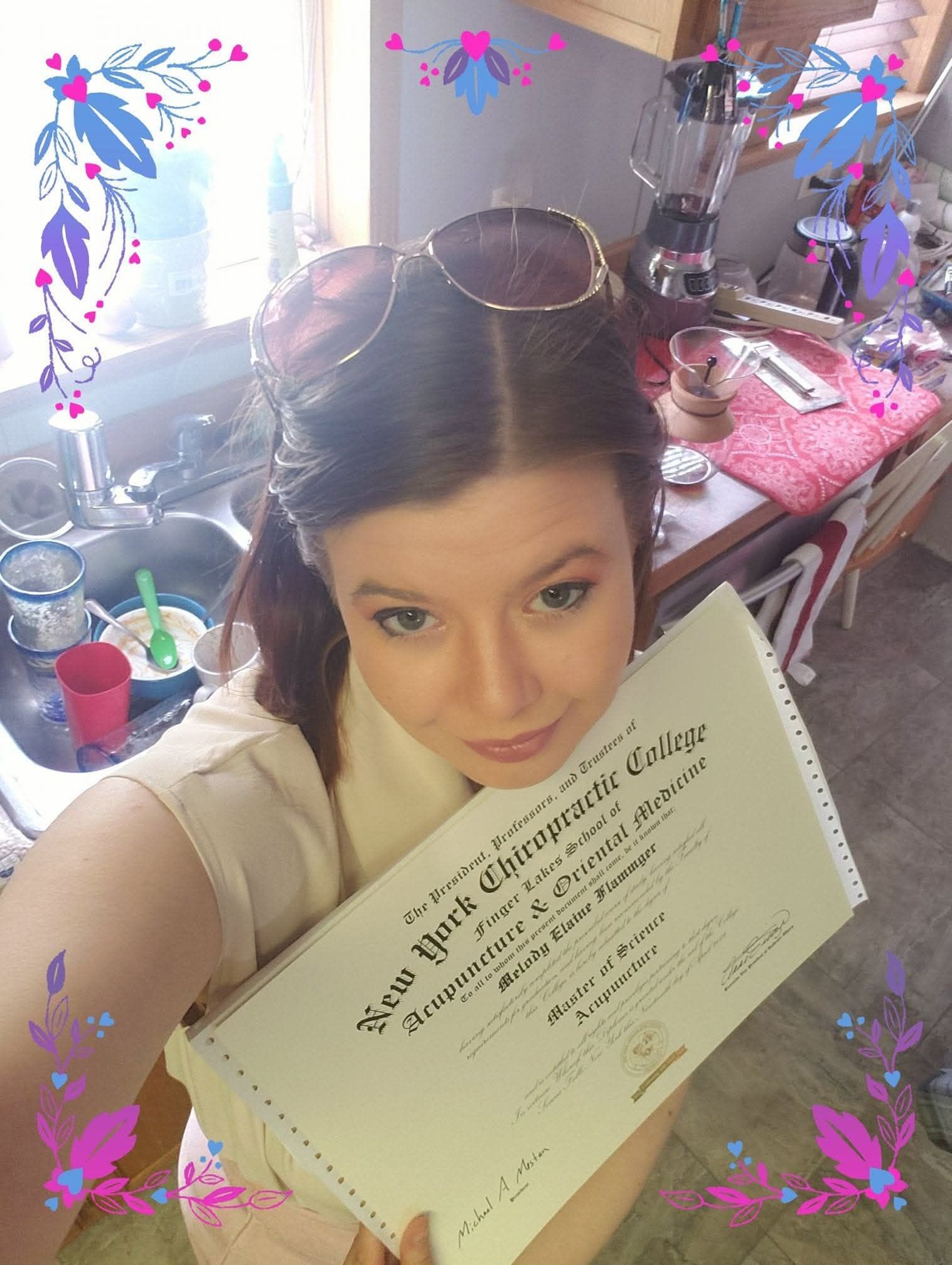
I came across someone offering to teach a traditional Chinese medicine concept- a channel, a vessel, a structure that runs through the very core of a person- with no discernible training, no lineage, no hours logged under anyone who actually knows the terrain. Just a title of a different kind and a willingness to speak with authority about something they haven't studied, and the longer I sat with it, the more I realized this wasn't really about that person at all. It was about a pattern I keep seeing, over and over, in this strange and beautiful world of healing that I've given my life to.
And here's the thing: I'm not annoyed because I think knowledge should be gatekept. I'm annoyed because these concepts are not metaphors or vibes or trends to be jumped on. They're living structures that show up in real clinical patterns: rebellious qi, dampness pouring downward, the feeling of being unmoored from your own center. When you've sat with someone whose body is tangled in grief and hormonal chaos, you don't treat these things like poetic ideas. You treat them like a living system that responds to a needle placed with intention and precision.
So when someone with no discernible training stands up and calls it "alchemy," I have to ask: what exactly is being transmuted here? Because from where I sit, it looks like the transmutation of other people's legitimate study into personal charisma.
I've written before about how a license is a minimum standard, not a measure of healing presence. I still believe that- but there's a difference between saying "credentials aren't everything" and saying "credentials aren't needed" and I think we've slipped, culturally, into the latter.
The academic rigor required for a New York acupuncture license: the anatomy, the point categories, the needling depth, the clean needle technique, the contraindications, the red flags, exists for a reason. It's not bureaucracy for its own sake- it's the difference between someone who knows where the lung is and someone who might give you a pneumothorax (collapsed lung). It's the difference between a treatment that supports a body and one that harms it, and I've seen enough in my years of practice to know that the line between those two things is thinner than most people want to believe.
More than that, it's a form of consent. When you lie on my table, you know that I have been vetted. You know that I sat for exams, that I've been observed, that I'm accountable to a board. That title : L.Ac. is a promise. It says: I have submitted to something larger than my own confidence.
The person with the stage? There's no board. There's no accountability. There's just a platform.
I'd be lying if I said I didn't also feel the sting of something else. Because part of my annoyance is envy. Not of their platform - of their freedom.
They get to be poetic, they get to skip the insurance billing codes and the CEU requirements and the registration fees and the endless documentation that has nothing to do with healing. They don't have to worry about whether their talk reimbursement constitutes fee splitting or what their professional liability could be. They don't have to justify their existence to a state board that seems to view us as a nuisance at best.
And here's what really chafes: the rules I'm bound by don't just restrict what I can say- they restrict what I can do.
As a licensed practitioner, I can't work in an employee capacity where the owner or operator doesn't also hold a license. I can't even teach on any online platforms unless I'm paid a flat fee rather than a percentage - because percentage-based compensation looks too much like fee-splitting, which is prohibited under New York Education Law . The same law that protects patients from exploitation also constrains how I can share what I know, and there are days when that feels less like protection and more like a cage.
Meanwhile, someone with no license faces none of these restrictions. They can teach wherever they want, charge whatever they want, partner with whomever they want. They can build an audience and a brand and a following without ever having to answer to a board. They can monetize their "wisdom" in ways I am legally prohibited from doing.
And sometimes, honestly, I wonder: was the legitimacy and accountability worth the burden of hundreds of thousands of dollars in debt?
The answer, I think, varies from day to day.
Because here's what bothers me most, and I've been struggling to name it precisely. It's not the lack of a license. It's not even the lack of lineage, though that's part of it. It's the lack of training — and the way the spiritual community has spent the last decade or so convincing itself that training doesn't matter. There's been an anti-academia current running through the wellness world for a long time now, and I understand where it comes from. I really do. I get that formal education is expensive and it's gatekept. It's often inaccessible to people who don't have the money or the time or the institutional backing to pursue it. There's a legitimate critique buried in there, and I don't want to dismiss it but somewhere along the way, "college is flawed" became "college is worthless," and "credentials aren't everything" became "credentials are a trap," and "lived experience matters" became "lived experience is all that matters." And now we have a culture where someone can spend a weekend in a yurt and come out the other side calling themselves a practitioner, and anyone who questions it gets accused of being elitist or exclusionary or gatekeepy. I'm tired of it.
Because training is not the same thing as lineage, and lineage is not the same thing as a license, and we've collapsed all three into a single slur we throw at anyone who suggests that maybe, just maybe, there's a difference between someone who has studied something for years and someone who hasn't.
Training is the hours. It's the repetition. It's the memorization of anatomy and the practice of needle technique and the slow accumulation of clinical experience under supervision. It's not glamorous. It doesn't make for good Instagram content. But it's what separates a practitioner from a dabbler, and no amount of intuition can substitute for it.
Lineage is something else entirely. Lineage is the transmission of a tradition from teacher to student, the passing down of a felt sense that can't be captured in a textbook. It's the relationship, the accountability, the "I learned this from someone who learned it from someone." You can have training without lineage. You can have lineage without formal training. They're different axes, and the wellness world loves to confuse them because confusion is convenient.
And nowhere is that confusion more convenient than in the story we tell about Reiki. Reiki is often held up as the gold standard of lineage: a tradition passed from master to student in an unbroken chain, with the Usui Reiki Ryoho Gakkai still guarding a line of presidents stretching back to Mikao Usui himself. And in its modern form, that's true. The lineage is real. The transmission is real. But where did Usui get it?
The honest answer is that we don't entirely know, and what we do know complicates the purity narrative in ways that make me uncomfortable with how casually we throw around the word "authentic." Usui was a product of his time and place, a Japan where spiritual seeking and cross-cultural exchange were swirling together, and he studied Kiko, the Japanese version of qigong, and traveled to China, and was influenced by Shinto and Tendai Buddhism and Shugendō mountain asceticism. The symbols and attunements of Reiki bear the fingerprints of esoteric Buddhist practice, and the hand positions correspond to energy centers that Hindu and Buddhist traditions had been mapping for centuries before Usui was born. The chakra system, so central to how Reiki is taught in the West, is a Hindu and Buddhist framework that Usui may never have used, and yet Western lineages absorbed it wholesale.
So what does that make Reiki? It makes it a synthesis. A beautiful, living, evolving synthesis of traditions that came before it. Usui didn't invent energy healing from nothing. He took what was available to him and forged something new, and that doesn't diminish Reiki. It makes it human but it does complicate the purity narrative, because if Reiki can trace its roots back to Chinese qigong and Indian chakra systems, then Usui took from cultures that weren't his own, and he did it without asking permission from the traditions he was drawing from, and that sounds an awful lot like the thing we're all so quick to call appropriation when someone else does it.
So what's the difference? I think it's this: Usui didn't pretend. He didn't claim to be practicing Chinese medicine or Indian tantra. He created something new and called it by a new name, and then he built a lineage around it. He trained students. He passed down a system with rules and ethics and expectations, and he submitted to something larger than himself.
The chiropractor, physical therapist or massage therapist offering "cupping" isn't building a lineage. They're not training in the system that created the technique. They're not submitting to the tradition- they're just taking the tool and adding it to the menu, and a menu is not a lineage.
That's the line of thought I keep coming back to. Rather than "who owns this technique" because the history of medicine is a history of borrowing, and pretending otherwise is a fantasy. But "who is accountable to the system they're borrowing from?" Usui was accountable. He studied. He practiced. He earned the right to synthesize. The wellness influencer with a weekend certification isn't accountable to anything but their own branding.
So yes, the title matters. The lineage matters. The training matters. But none of them are a claim of purity. They're a claim of responsibility. They're saying: I know where this came from. I know what it cost. I know what I owe.
Accountability, not ownership, is the thing that no amount of charisma can replace.
Which brings me to the thing I actually sat down to write about, and I've been dancing around it long enough.
This isn't hypothetical. It's happening all around us, and it's accelerating in ways that should concern anyone who cares about the integrity of traditional medicine. The most egregious example is dry needling, and I don't think it's an exaggeration to say that this is an existential threat to our profession.
Physical therapists in over thirty-five states have successfully lobbied to include "dry needling" within their scope of practice, a term that is, functionally, just acupuncture by another name. They insert filiform needles into trigger points for therapeutic purposes, they call it something different, they claim it's not acupuncture because it's based on Western anatomy rather than Chinese Medicine theory, and state legislatures have largely bought it, because "dry needling" sounds like something a physical therapist would do and "acupuncture" sounds like something that requires years of training they'd rather not pay for.
The training requirements tell the story. In some states, physical therapists can perform dry needling with as little as fifty-four hours of training, forty hours of theory and forty hours of supervised practice, according to one account I found. Compare that to the three thousand or more hours required for acupuncture licensure in New York, the years of clinical supervision, the study of point functions and indication, the understanding of when not to needle.
New York has, so far, resisted this encroachment. Under New York Education Law Article 160, dry needling is legally defined as acupuncture, and only licensed acupuncturists and physicians with specific training can perform it, and physical therapists and chiropractors are explicitly prohibited. This is not a small victory. It's the result of sustained advocacy by the acupuncture community, and it's one of the strictest regulatory stances in the country.
But the pressure doesn't stop. In California, a recent bill initially sought to expand physical therapists' scope to include "tissue penetration using filiform needles," dry needling by another name, and the acupuncture community mobilized, and the World Federation of Acupuncture-Moxibustion Societies, the American TCM Association, and the California Acupuncture Alliance pushed back hard, and the dry needling provisions were ultimately removed from the bill. It was a win. But it was a fight, and the fight will come again, because it always does.
This is what appropriation looks like in practice. It's not always someone standing on a stage calling themselves a reverend. Sometimes it's a legislative committee room. Sometimes it's an influencer's website. Sometimes it's a professional adding "cupping" to their service menu after a weekend workshop. The pattern is always the same: take the technique, leave the tradition. Take the tool, discard the knowledge. Take the market share, refuse the accountability.
And the practitioners who spent years, sometimes decades, learning these systems? We're told to be gracious. We're told that sharing is caring. We're told that healing belongs to everyone.
But healing doesn't belong to everyone who wants to sell it. Healing belongs to the people who submit to the training, who honor the lineage, who understand that these techniques are not tricks. They are medicine. And medicine requires more than good intentions and a willingness to charge for it.

