Melody's Musings
Bearing Witness, Eyes Full of Wonder
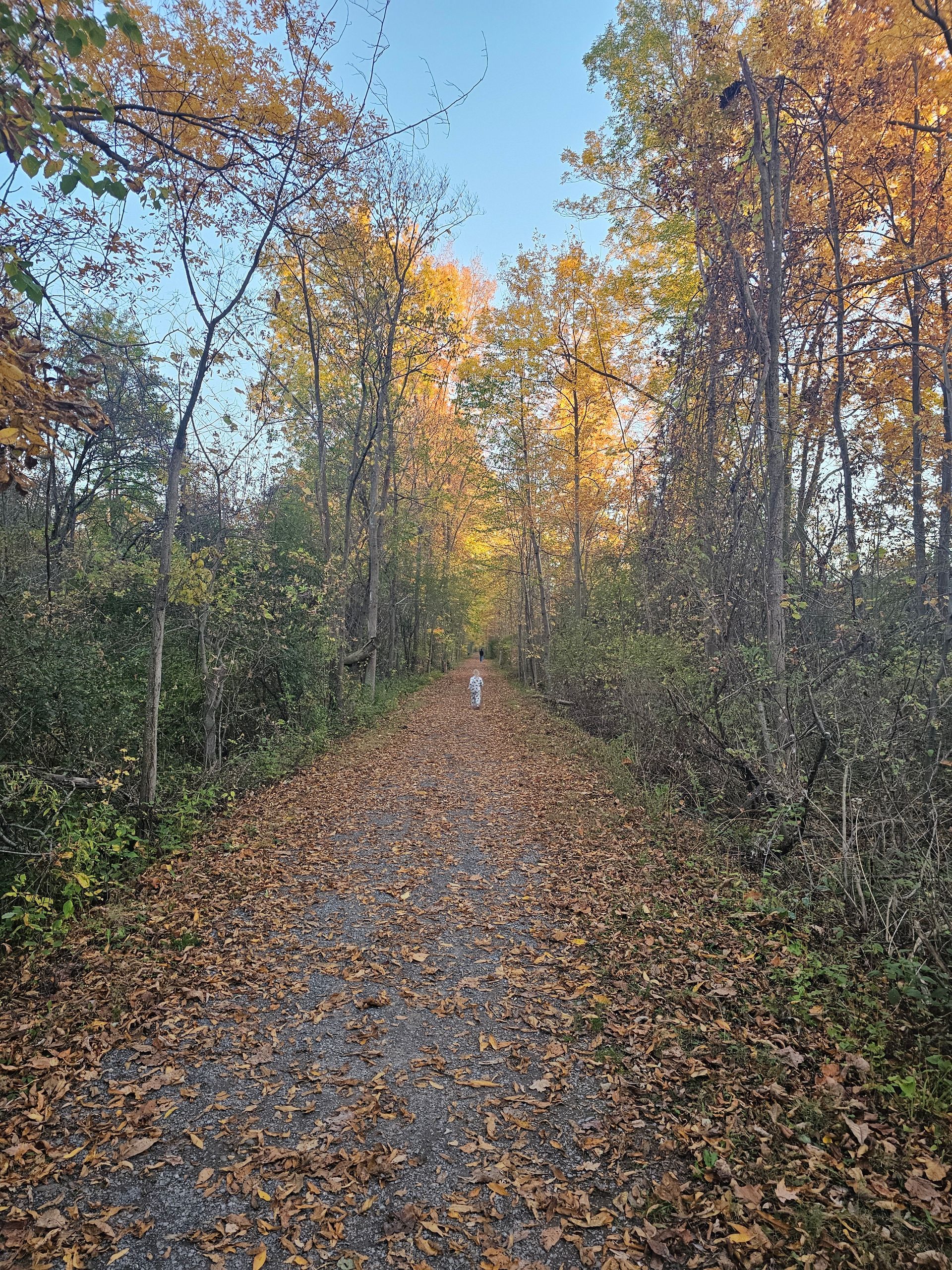
This is a photograph I took on a trail earlier this week. My son is ahead of me, running. His back is to me and he's moving, and the picture catches the moment I realized he wasn't waiting for me to catch up. I noticed it while it was happening, and I snapped the photo because it felt like such a perfect illustration of how he is charging full speed ahead into the future, without looking back.
In acupuncture clinic, we chart our encounters in a SOAP note: subjective, objective, assessment, plan. The subjective is what the patient tells you, while the objective is what you find: the shen in their eyes, the color and features of the tongue, the pulse, the quality of the skin and nails, the sound of the voice and the breath, what your hands find when you palpate. The four examinations are looking, listening and smelling, asking, and palpating, and three of them land in the objective, which means observation lives there. It's the information that doesn't come through language, the things you know without being told. You have to turn your attention outward to do it. You have to stop, and look, and listen to what a body is saying when the person hasn't said anything at all.
We learned it in TCM Theory II. One trimester, less than four months of the whole training, covering pulse and tongue diagnosis. That was the formal instruction. What I remember is that I was good at it, and not because I'd memorized anything. The memorization was the part I had to grind through. The other part came easily. Putting my fingers on someone's wrist and feeling the different qualities of the pulse. Looking at a tongue and seeing what was actually there instead of what the textbook said should be there. I didn't have to work at that. I had to work at everything around it.
Here's the part I've had to be honest about since. I'm neurodivergent, and the default setting isn't mine. I came into training already noticing everything: the shift in someone's voice, the thing they were doing with their hands, the second they stopped breathing. What the training gave me wasn't the noticing. It was a vocabulary for it and a chart to put it in. What I actually had to learn was how to stop, how to file what I saw, and how to keep my face from showing that I'd seen it. In social situations it's exhausting. People can feel scrutinized without knowing why.
But I've watched colleagues build the other version of this skill, and it's real. Most people have to learn to turn their attention outward. We're taught the opposite, honestly. To check in with ourselves, notice our own breath, our own thoughts, our own reactions. All of that is good. Mindfulness, grounding, glimmers. But it keeps the camera pointed at the person holding it. You can be the most self-aware person in the room and still walk right past the thing standing in front of you.
Observation is a different direction. You turn your attention outward and hold it there, on something that isn't you and isn't yours to fix, and you don't take it in to feel better. You take it in because it's there.
And this is where I need to be careful, because I've been using two words like they mean the same thing and they don't. Observing and witnessing are not the same act. Observing is noticing what's there. Witnessing is staying with it when staying costs you something. You can observe a tree. Nothing is asked of you. Spotting a butterfly is observation. It's a gift and it's free. But seeing an unhoused person and not looking away, that's witnessing. The looking away is the thing you want to do and you're choosing not to. Being with a laboring person is witnessing. You're holding space in a room where something enormous is happening and you can't fix any of it. You're just there. The child running ahead of you, toward a future you're not ready for, is witnessing. You have to watch him go.
So the two aren't the same and I don't want to flatten them. Observation is the trained skill, and for me it isn't even trained, it's automatic. Witnessing is the choice to let what I observe become presence instead of information. That's the part that's hard. Noticing the fairy village is easy. It's delightful, it stops you on its own. The test isn't the fairy village but rather the thing you'd prefer not to look at. Noticing those is the same skill. Staying with them afterward is the actual discipline, because everything in you wants to look away, or fix it, or schedule it, or move on to the next thing.
Bearing witness is hard. Not because noticing is hard. Because staying requires sitting with the discomfort.
I've been talking about observation like it's a choice I make. For me it mostly isn't. It runs whether I ask it to or not, and the strangest thing about it is how often it arrives before I know I'm doing anything at all.
Back in June, I'd gotten a new oracle deck (the Archetypes deck by Kim Krans) and I was out in the yard working when my neighbor stopped over to ask me about our family's spiritual beliefs. I asked if she wanted to see the new deck and pulled a single card for her: The Mother (the significance of this card later became apparent as she was expecting another child). We read the book description together and she was so excited she called her cousin over. The cousin drew The Womb. I read the description out loud, and she looked at me and asked, "What can you tell me about me based on the card you just read?" And I blurted out, without thinking: "Do you have endometriosis?"
There's no logical way I should have known that. I don't know her. I don't know her name. When I played the interaction back later, I understood it wasn't the card at all: it was the pain in her eyes when she drew it. The diagnosis was a lucky guess, in the sense that my Facebook reels have been full of endometriosis videos for a year and my brain had the word ready. The guess wasn't the noticing: it was the eyes. My nervous system had been collecting data the whole time: the pain, the hesitation, the way she held her face. And it spat out the analysis before I knew I was doing any analysis at all.
That's when I stopped thinking of it as only a clinical skill. It's still that! It's what I do in the treatment room, and it's the same thing I do on a trail with my son, but it's a bigger thing than the clinical setting. The closest analogy I have is Sherlock Holmes, whom I've always read as an autistic archetype: the character who notices the mud on your cuff and the callus on your hand and the way you hold your mouth, and then arrives at a conclusion that looks like magic to everyone in the room because they didn't watch him do the math. That's the thing people mean when they call it psychic. It isn't psychic. It's a nervous system that never learned how to stop collecting data, and a mind that runs the analysis whether you asked it to or not.
I experience it as a gift. I take in all the data and I spot the patterns, and I can do it faster than most people in the room. It's the thing I'm good at. It's also expensive software to run. I can be fully present with a patient for hours and come home with nothing left for a normal conversation. I can notice everything about a stranger's face and completely miss that something in my own home needs tending. The clinical work takes me away from my son more than I'd like, and then the noticing takes the rest. Both things are true. It's a gift and it costs me, and I've stopped trying to pretend one of those isn't happening.
I've noticed my son is so much like how I used to be as a kid, running ahead. I was in such a hurry to grow up and everyone around me kept saying slow down and I thought they were being tedious. Now I'm the one saying it and I understand it in my body, in the part of me that wants to grab his hand and make the trail last longer. They weren't trying to hold me back. They were trying to keep the version of me that was still there.
Because that's the thing nobody tells you about watching a child grow: it isn't just that they change, it's that each new version replaces the last and you don't get to keep any of them. I love the person he's becoming and I also miss the ones he's already left behind, and there's an ambiguous loss in that, because he's not gone- he just grew. There's a grief in it and it's an uncomfortable one, because you're not supposed to grieve your child growing up, you're supposed to be proud. I am, I'm so proud, but bearing witness to change is still bearing witness and the discipline is the same one I keep returning to: you meet him where he is. Not where he was, not where you wish he'd stay, but where he is right now, running ahead of you on the trail. Observation isn't just clinical. It's the thing that makes love possible too, because you can't meet someone where they are if you haven't noticed where that is.
Here's the part I didn't expect. The photograph was taken moments before we found the sycamore. He ran ahead, I followed, and the walk kept offering. A few weeks before it had offered a fairy village tucked onto a tree stump, tiny houses with tiny windows, a gift for anyone who happened to look, and he'd stopped for that one; and then on this walk, a hollow trunk at the base of a sycamore, dark and open, just big enough to imagine slipping through. A doorway, he said. To the fairy world.
I've been thinking about thresholds all season: the ones we find, the ones we're let into, the ones we can't keep , the ones we cross without thinking. Before we know it, we're a different version of ourselves. I've become so many versions of self over the decades- we all change and shift and grow if we're really living. My son is always becoming someone I haven't met yet, and my job is to keep noticing him, the wonder in his eyes and the sound of his voice and the way he runs, and to keep letting each version go as the next one arrives.
You can only find wonder if you notice. Wonder isn't a feeling that lands on you, it's what you see when you stop and turn your attention outward and let the world be what it is instead of what you assumed. The fairy village was there for weeks before we found it. The sycamore was there before we walked past it.
He came into this world to a Tool song. Pneuma: Greek for breath, spirit, the animating thing. I've been listening differently lately, especially the end:
Reach out beyond
Wake up, remember
We are born of one breath, one word
We are all one spark, eyes full of wonder
Eyes full of wonder. That's him. That's the thing I'm trying to protect and the thing I have to let go of at the same time, and he's going to reach out beyond, and that's not a loss. That's the whole point of him.
I'll keep following, for as long as he lets me. And I'll keep noticing. That's what my senses are for.